 English
 Deutschat launch
 Portuguêsat launch











































Application
Micfil Ultrafine filters for engines and gear
Although the lubricating gaps in the engine have a size of approx. 1.5 to 10 µm (µm = micron), the usual standard oil filters only have a filter performance of up to approx. 10 µm.
Better lubrication and less wear without oil change.
- Removes solid impurities up to 0.5 um
- Up to 20 times higher filter performance than standard filters
- Significant improvement in lubrication
- Longer service life due to less wear and tear
- Better engine performance due to less friction
- Elimination of conventional oil changes
- Additives, Additives, are not filtered out and through ultra-fine filtration there is less consumption
- Lower maintenance and repair costs
- Active environmental protection through lower oil consumption and elimination of waste oil disposal
- Does not limit the warranty of the engine manufacturer
- Elimination of approx. 98 % of all bacteria
- Removal of water from oils and fuels
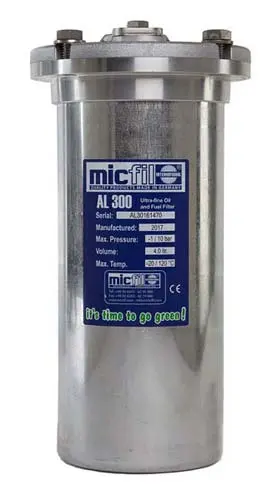
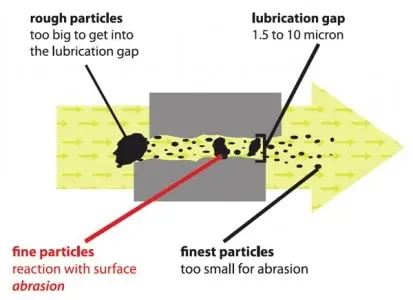
micfil filters offer up to 20 times higher filter performance than standard filters
Although the lubricating gaps in the engine have a size of approx. 1.5 to 10 µm (µm = micron), the usual standard oil filters only have a filter performance of up to approx. 10 µm.
International studies prove that the abrasion of particles in lubricating gap sizes is about three and a half times higher than that of particles above 10 µm. Standard filtration is therefore not sufficient.
During an oil change, part (approx. 15%) of the contaminated oil remains in the engine and the number of dirt and abrasion particles increases steadily during operation. The engine runs constantly in contaminated oil and solid particles cause further abrasion. Standard filters are also not able to filter out water, which can lead to acid formation.
The micfil ultra fine filter has a filter performance that is approx. 20 times higher than that of standard filters. Dirt, combustion, oxidation and abrasion particles of up to 0.5 µm causing abrasion are constantly filtered out of the oil.
The smaller particles remaining in the oil do not cause any damage; on the contrary, they increase the load-bearing capacity (lubricity) and the thermal load-bearing capacity of the oil.
The high-performance filter element, which consists mainly of cellulose, binds water and bacteria and thus counteracts acid formation and protects the alkaline reserve in the oil.
REICHERT friction wear test
Left: Abrasion with fresh oil
Right: Abrasion after 350,000 km with used and filtered oil
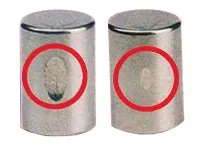
Better lubricity than fresh oil
The load-bearing capacity (lubricity) and the thermal load-bearing capacity of the finely filtered and non-exchanged oil are significantly increased compared to fresh oil by enrichment with carbon and other solids of a size that does not cause abrasion.
The particles of less than approx. 1 µm in size remaining in the oil during ultra-fine filtration do not cause any damage; on the contrary, they increase the load-bearing capacity and the thermal load-bearing capacity of the oil.
The longer the oil is used, the better these properties become.
Lower oil consumption
Besides lubrication and cooling, one of the main tasks of the oil is the fine sealing between sliding parts such as piston rings against the cylinder wall. The micfil ultra fine filtering of the oil constantly filters out solid particles which can impair the fine sealing capability of the oil. As a result, less oil can enter the combustion chamber and oil consumption is reduced.
Click on the image to enlarge.
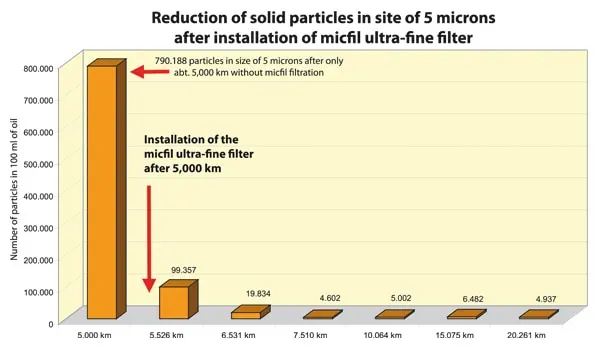
Elimination of conventional oil changes
Oil does not age, but the use of oil in engines causes a process of change, caused by dirt and abrasion particles, combustion residues (soot), oxidation products, bacteria and water.
The micfil ultra fine filter absorbs water and constantly filters out solid particles that cause abrasion. This prevents the formation of acids and the solid particles of less than approx. 1 µm remaining in the oil improve the lubricity and thermal resilience of the oil.
The longer the oil is used, the clearer this optimization becomes. An oil change is therefore not necessary for technically flawless engines.
The micfil ultra fine filter acts like an oil recycling system on the engine. Nevertheless, other causes (e.g. overheating, material defects, etc.) can cause damage to the engine. The technical condition of the engine should therefore be checked regularly by oil analyses or by means of an oil test device. Damage to the engine should be analysed and repaired. It cannot be repaired even by changing the oil.
The REICHERT friction wear tests can be used to demonstrate that the lubricity of the oil has improved over that of the respective fresh oil.
It is recommended to regularly monitor the technical condition of the engines by comparative oil analyses.
Laboratory report oil analysis: engine oil of the MS Capibara
Filtered with Micfil ultrafine filters: no oil change necessary.
Evaluation of the current laboratory values:
“All determined values are within permissible tolerances. The condition of the oil is classified as normal.”
| Current sample | Previous investigation | |
|---|---|---|
| Sample No. | 26065751 | 26056339 |
| Examination date | 15.09.2014 | 10.03.2012 |
| Date of last oil change | – | – |
| Refill quantity since change | – | – |
| Duration since change | – | 3893 |
| Total term | 103800 | |
| Oil changed | – | – |
Wear metals
| Current sample | Previous investigation | |
|---|---|---|
| Ferric (Fe) mg/kg | 4 | 9 |
| Chrome (Cr) mg/kg | 0 | 1 |
| Tin (Sn) mg/kg | 0 | 1 |
| Aluminium (Al) mg/kg | 1 | 2 |
| Nickel (Ni) mg/kg | 0 | 0 |
| Copper (Cu) mg/kg | 1 | 1 |
| Lead (Pb) mg/kg | 2 | 2 |
| Molybdenum (Mo) mg/kg | 52 | 60 |
| PQ Index | OK | OK |
Impurity
| Current sample | Previous investigation | |
|---|---|---|
| Silicon, dust (Si) mg/kg | 0 | 0 |
| Potassium (K) mg/kg | 2 | 2 |
| Sodium (Na) mg/kg | 1 | 0 |
| Water content % | 0,00 | 0,00 |
Additives
| Current sample | Previous investigation | |
|---|---|---|
| Calcium (Ca) mg/kg | 2156 | 2774 |
| Magnesium (Mg) mg/kg | 5 | 18 |
| Boron (B) mg/kg | 1 | 4 |
| Zinc (Zn) mg/kg | 555 | 793 |
| Phosphor (P) mg/kg | 793 | 793 |
| Barium (Ba) mg/kg | 0 | 1 |
| Sulphur (S) mg/kg | 8036 | 8036 |
Oil condition
| Current sample | Previous investigation | |
|---|---|---|
| Viscosity at 40°C mm²/s | 154,19 | 155,77 |
| Viscosity at 100°C mm²/s | 15,2 | 16,0 |
| Viscosity index | 99 | 107 |
| Base number/TBN KOH/g | ||
| Acid number/TAN KOH/g | 2,59 | 2,10 |
| i-pH value | 5,37 | 6,51 |
| Oxidation A/cm | 3,08 | 2,29 |
| Nitration A/cm | 0,69 | 0,28 |
| Sulfation A/cm | 0,00 | 0,00 |
| carbon black content % | 0,11 | 0,13 |
| Fuel content % | 0,21 | 0,00 |
| Dispersibility % |
Independent laboratory report of the company AKSOT Ölservice, Hamburg.
Click here to view the original document.
Talk to micfil
With just a small investment you have huge savings potential.
We would be pleased to have a personal consultation with you.